✴️ = best choice!
Download the map here
Please note: the underground is not open 24 hours a day, but only from 5 a.m. to midnight.
It is not included in the Japan Rail Pass, it seems complex but it is well organised.
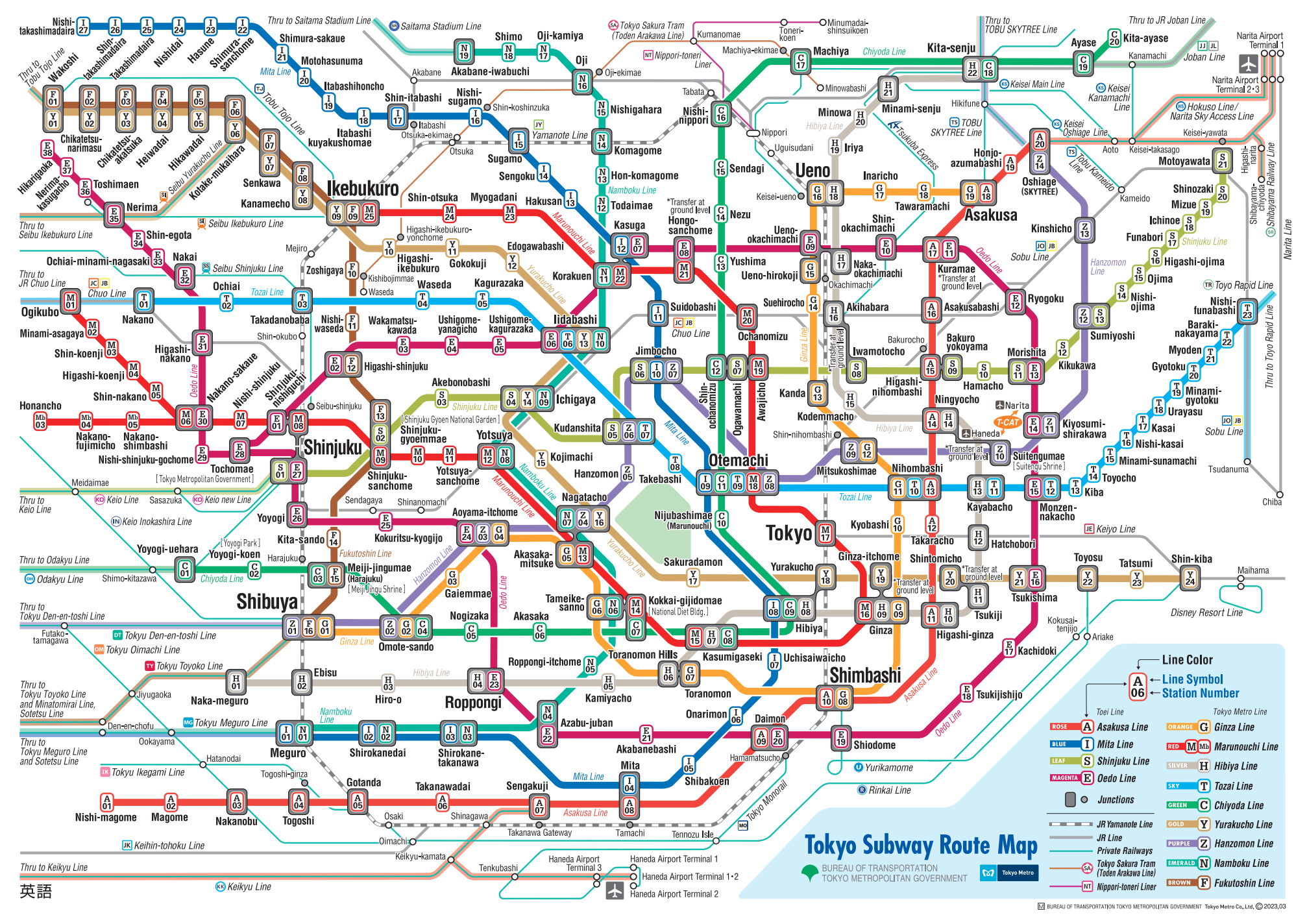
Download the map here
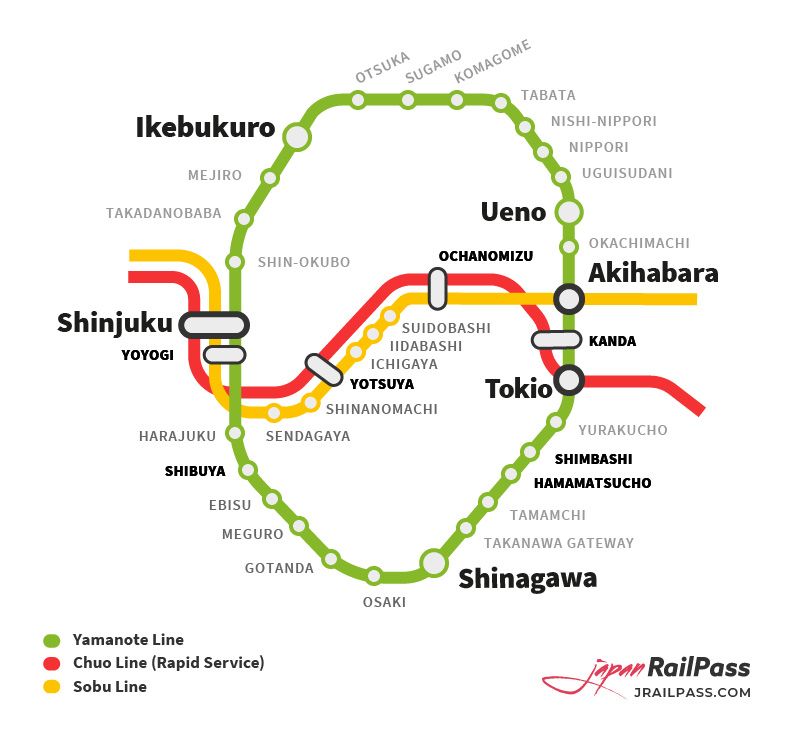
It takes you everywhere and, unlike the underground, is included in the Japan Rail Pass. Except in rare cases, we always preferred it for travelling between different neighbourhoods.
The main line, the green one (Yamanote line), runs in a loop around the city’s main districts.
The yellow line (Sobu line) and the red line (Chou line) cut through the centre.
Open from approximately 04:30 to 00:30
Our trip to Japan begins on 23 October, with a flight from Milan Malpensa Airport that takes us to Tokyo in about 13 hours. We arrive at Haneda Airport – where many international flights land – the following morning.
After going through the various checks and obtaining our temporary visitor visas, we head to the Tokyo Monorail (Haneda Express) departure point, still inside the terminal, arriving at Hamamatsuchō station in about 15 minutes.
For this trip, we decided NOT to purchase the Japan Rail Pass – a travel pass for Japan Railways (more information here) – as we will be renting a car for several days to travel to more remote rural areas.
We all pay for public transport with the Suica rechargeable card (see link above).
The cost of the Tokyo Monorail, for example, is approximately 500 yen (approximately € 3.00).
From Hamamatsuchō Station, we take the Yamanote Line to Ueno, the neighbourhood where we spend the day.
It was our first time in this neighbourhood and we have to say that, among many others, it is one of our favourites: quiet and surrounded by greenery, but at the same time full of bars and shops.
We spent the day at Ueno Park, enjoying street food, bonsai exhibitions and school trips.
You can download the park map here.
At lunchtime, we stopped first at the park, where there were several street food stalls. We tried some Hiroshima-yaki (a variation of okonomiyaki with soba noodles), chestnuts and fried chicken, then finished off with a few pieces of sushi at a nearby restaurant.
For dinner, we managed to find a table at Gyokatsu Motomura: a tiny restaurant on the main street, where they serve a single dish, their speciality – a beef cutlet available in various sizes, accompanied by a selection of side dishes. ✴️


One of the goals of this trip was to see Mount Fuji, something we hadn’t been able to do during our first visit to Japan. So we set off for the lakes at the foot of Fuji, hoping to photograph it on a clear day. Our first destination was Lake Kawaguchi.
To get there, we took the Yamanote line from Ueno to Shinjuku station and then the Kaiji train on the JR Chūō Line.
The train is direct only during certain times of the day; in most cases, you need to change at Otsuki Station, where the train splits into two to continue in different directions. All seats are reserved: if you don’t have a reservation, you can still board by paying with your Suica card and paying a supplement on board. You can find the timetable here.
The main town on the shores of the lake is Kawaguchiko. As soon as we arrived, we took a walk along the lake: on clear days, you can enjoy a splendid view of Mount Fuji from here, with some particularly striking views along the way, where the mountain appears framed by the red leaves of the maple trees. Unfortunately, we were unlucky with the weather and the sky was completely overcast.
Despite this, we decided to visit one of the most famous viewpoints in the area: Chureito Pagoda, located above the town of Fujiyoshida. Even without the view of Mount Fuji, the pagoda is worth a visit (the interior is not accessible). It is advisable to go early in the morning or at sunset, as during the day the area is literally stormed by organised day trips from Tokyo.
At lunchtime, we stopped near the lake for ramen at Hao Stay Coffee, the restaurant of a local guest house. Nothing exceptional, but there are few alternatives in the area.
For dinner, we tried a tempura set at Fuji Tempura Idaten: the tempura was good, but we found the bill rather expensive.
Very basic room, exactly as described.
A lovely, well-kept guest house with fair prices for the area.
We start the day with an excellent breakfast at Hao Stay Coffee, the homestay’s café where we had lunch the day before. The breakfast is truly delicious: a wide selection of pastries, a welcoming and refined atmosphere. We opt for walnut and almond muffins, bread with peanut butter, accompanied by fresh fruit and coffee.
A five-minute walk from the café takes us to the Toyota Rent a Car office, where we pick up the car we will use during our trip and return in six days. We chose to rent it because the places we will visit are mountainous and more remote areas, often poorly connected by public transport. It also allows us to move around more freely and stop along the way whenever we come across places that seem worth an impromptu visit. We booked the rental before our holiday, directly on the agency’s website, for a total cost of €320.00 (insurance included).
A brief note: in Japan, you can hire a car if you have an international driving licence, which can be obtained simply by applying to the ACI, paying a fee and without having to take any tests.
In addition, driving is on the left, so you have to expect a minimum of initial difficulty: especially when leaving parking spaces, it is easy to drive into oncoming traffic. Nothing impossible, however, because you get used to it quickly.
The car assigned to us was a Toyota Aqua with manual transmission. Finding your way around is easy thanks to Google Maps (or Apple Maps) and road signs, which are often bilingual.
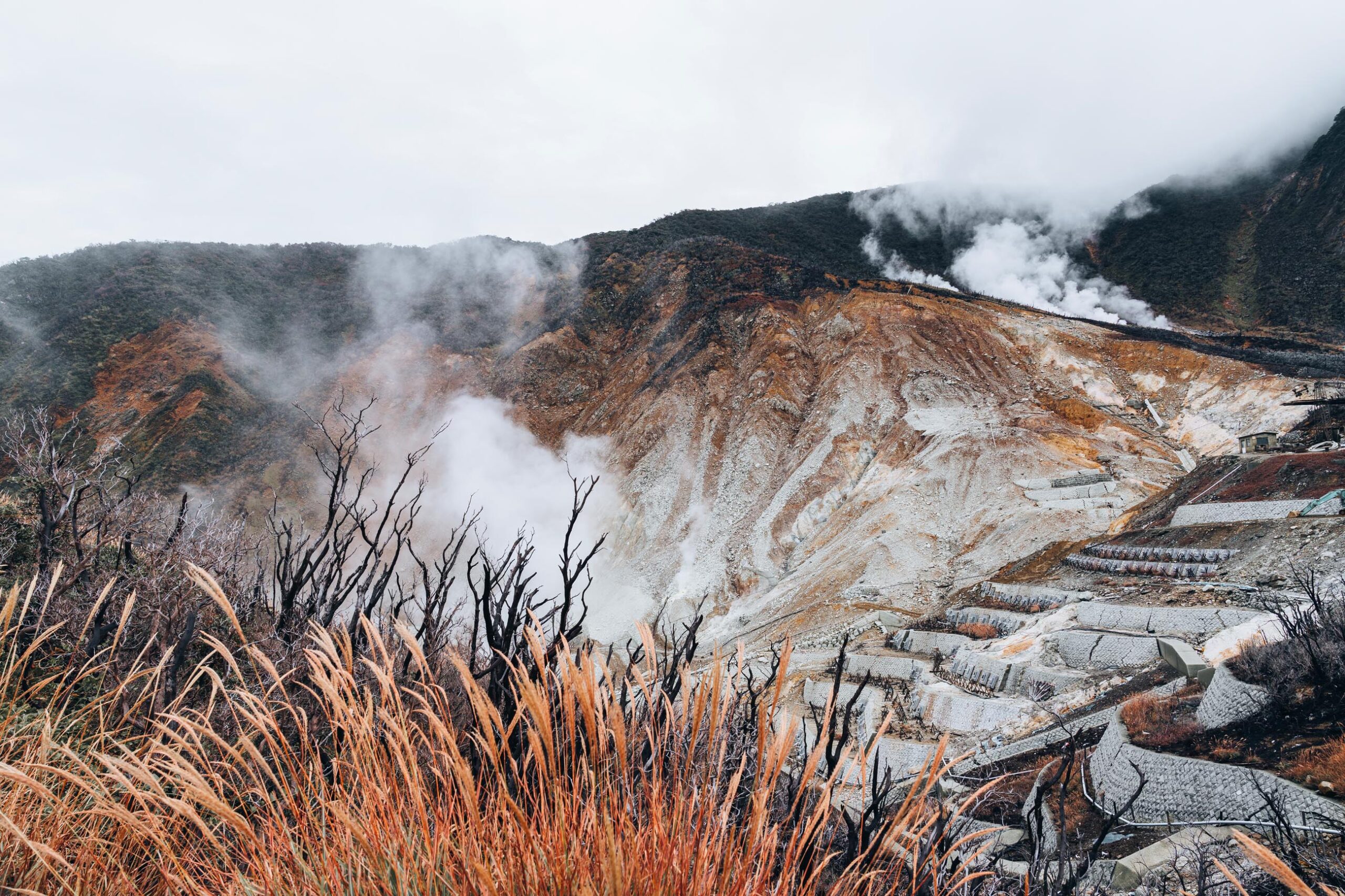
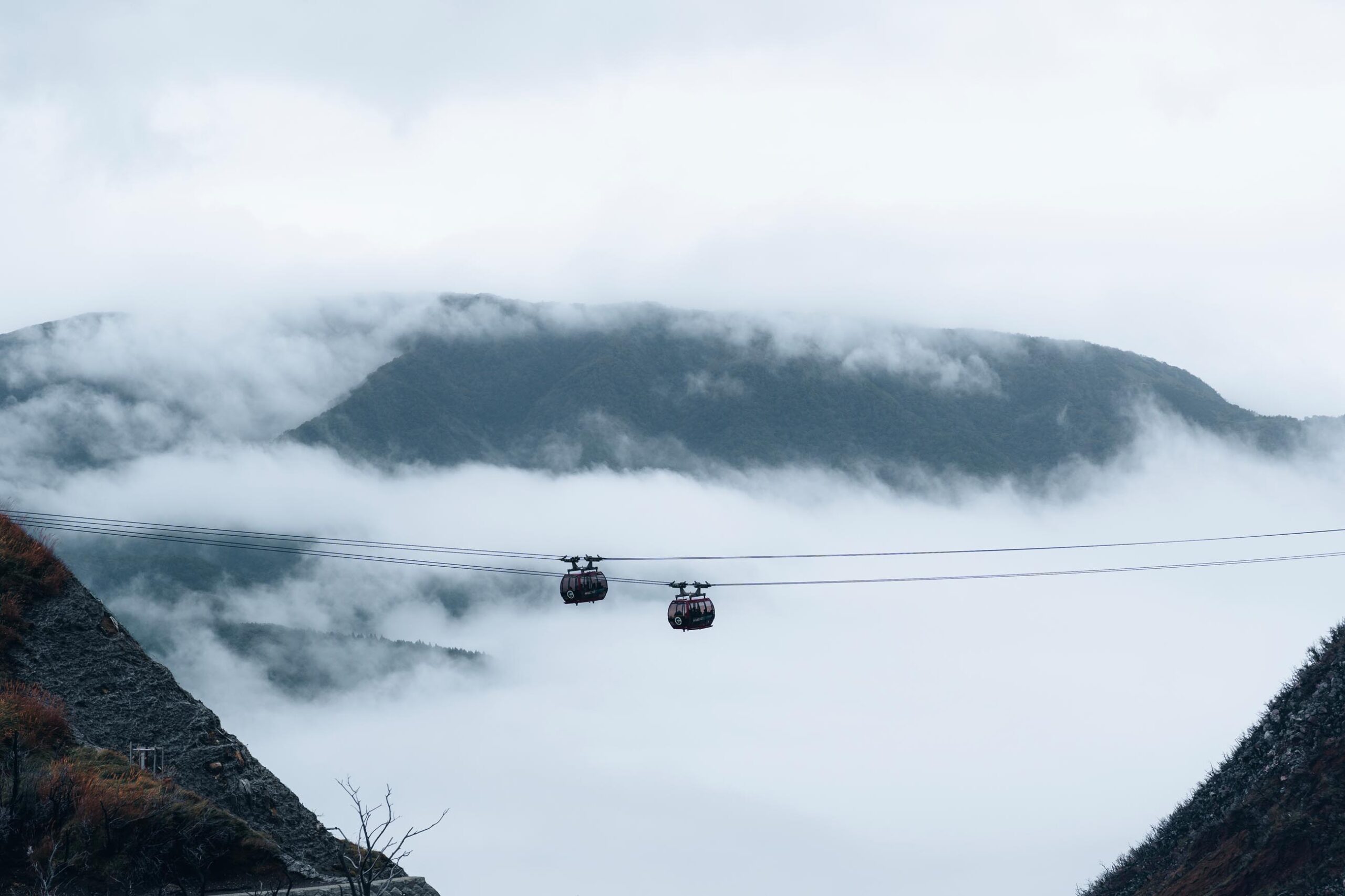
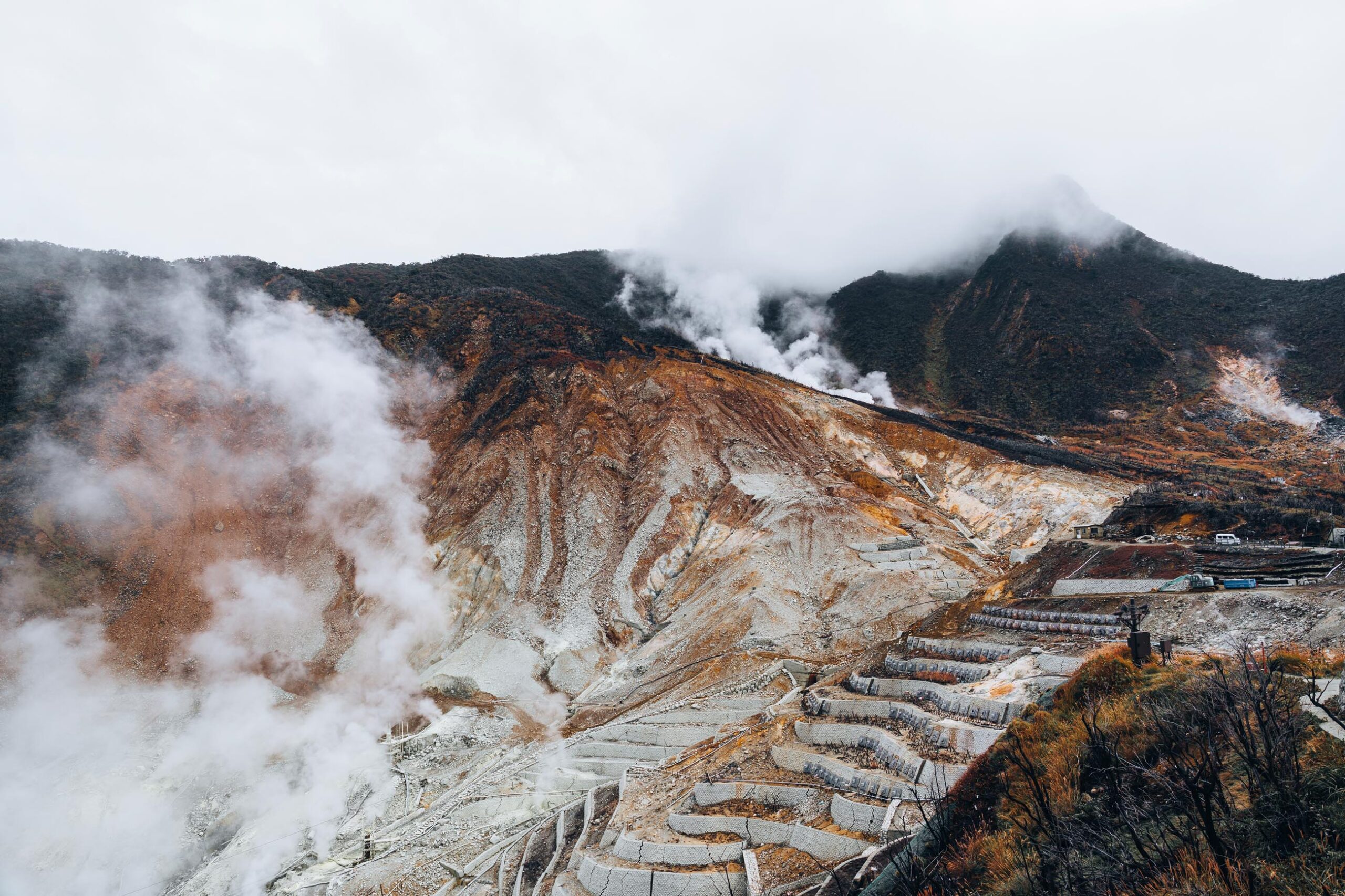
Our first destination is Lake Ashi, which we reach after about an hour’s drive. We leave the car at the port and, from Togendai station, take the cable car to Owakudani, the famous sulphurous area in the region.
Also known as the ‘Valley of Hell’, Owakudani is an ideal destination for photographers, nature lovers and geology enthusiasts. This area was formed about 3,000 years ago following a violent eruption of Mount Fuji. Today it appears as an arid gorge, from which dense clouds of steam rise and boiling water springs gush forth.
The landscape is dominated by intense, contrasting colours, ranging from bright yellow to red, creating an almost surreal scene. On clear days, with a bit of luck, you can even see the outline of Mount Fuji on the horizon.
There are only a couple of restaurants in the area. Here you can try the famous “black eggs”: hard-boiled eggs cooked in hot volcanic waters, which blacken the shells, and black curry bread, delicious crispy croquettes that are decidedly greasy.
Before evening, we arrive at the hotel to check in and relax in a private onsen: there is one indoors and one outdoors, both of which are also accessible to couples and those with tattoos.
For dinner, we drive to the nearest town, Gotemba. Here we choose Yakiniku En Yoshino, a spacious restaurant frequented by locals. The atmosphere is lively and informal, typical of yakiniku restaurants, with tables equipped with grills where you can cook your own meat.
The menu offers Korean-inspired specialities, including generous mixes of “fatty” meats to be grilled to order.
A perfect place for cat lovers… less so for those who don’t appreciate cats (or are allergic to them). The real highlight of the property is the private onsen, which can be booked on the spot and is also accessible for couples, ideal for relaxing in peace.
On the downside, however, the cleanliness leaves something to be desired.
Privacy Settings
This website uses cookies to improve your experience while you navigate through the website.
View the Cookie Policy View the Personal Data Policy
Google Fonts è un servizio per visualizzare gli stili dei caratteri di scrittura gestito da Google Ireland Limited e serve ad integrare tali contenuti all’interno delle proprie pagine.
Luogo del trattamento: Irlanda - Privacy Policy